![India vs South Africa 3rd T20I clash at Dharamshala [Source: AFP Photos]](https://onecricketnews.akamaized.net/parth-editor/oc-dashboard/news-images-prod/1765796539930_india_vs_south_africa(1).jpg?type=hq) India vs South Africa 3rd T20I clash at Dharamshala [Source: AFP Photos]
India vs South Africa 3rd T20I clash at Dharamshala [Source: AFP Photos]
The 'choker' tag and South Africa are synonymous terms, but that is for big tournaments and knockout stages, right? Wrong. The new Proteas era, nurtured by Aiden Markram and Temba Bavuma, can fire guns. The hitting ability, temperament and balance are there in the squad, yet there's something missing... Or is it?
The South Africa vs India clash at the HPCA stadium in Dharamshala on December 14 saw an absolute demolition of the South African batting lineup by Indian pacers. The total posted on the board was 117. Not their lowest, but one of their weakest.
In the 1st T20I against India at Cuttack, South Africa bundled out for 74 runs while chasing 176. Both loss, shambolic and exposes the blatant mistakes made by batters and maybe, also by the team management.
Too much change hurting South Africa?
South Africa changed their Playing XI for almost every match in the three-match ODI series, and the pattern crept into the T20Is as well. From what it looks like, South Africa has been experimenting with their lineup and is not too focused on the bilateral series itself.
However, it hurts the aspect of the game. Players don't feel settled enough if they keep switching places on and off the field. If it is not the primary, but it is one of the many reasons that the Aiden Markram-led team faltered in front of India's attack.
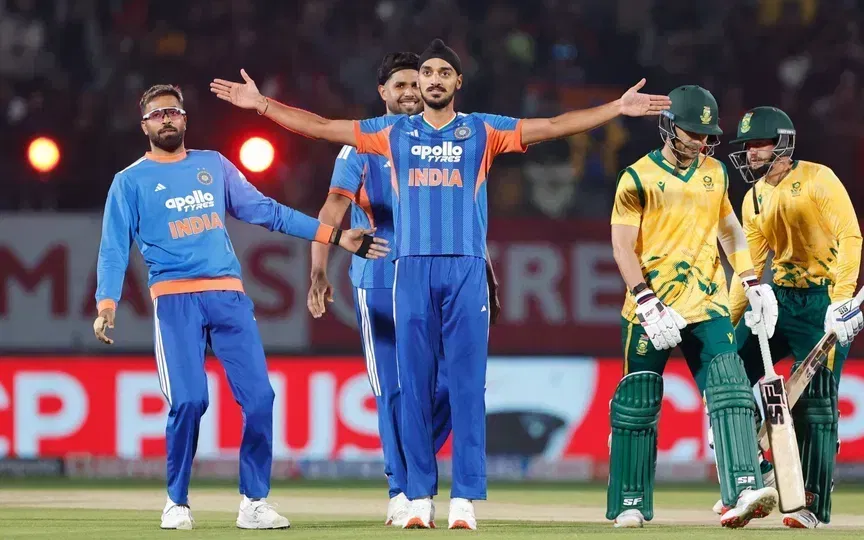
Arshdeep Singh scalped Reeza Hendricks in the fourth ball of the first over, and it was a stunner. Beautiful seam presentation from Arshdeep and visible lateral movement, bamboozled Hendricks, which led to an LBW.
Harshit Rana also delivered a work of art as his ball swung in the second over to send back Quinton de Kock, followed by a 144 kph to Dewald Brevis, who misjudged the pace and got an inside edge which uprooted his stumps.
But was it pressure that led to these quick tumblings? South Africa were not chasing at Dharamshala, and the pitch did have assistance in the form of moisture and dew, though not as pronounced as it usually gets later in the innings.
The damage done and the supremacy built
It wasn’t just Arshdeep Singh and Harshit Rana doing the damage. Varun Chakravarthy and Kuldeep Yadav also disembowelled the brute hitters of the visitors, which starkly underlined South Africa’s lack of application and adaptability against a high-quality bowling attack.
The Proteas were unstoppable in the Test series, but without the whites, their ability to handle India’s bowling comes under serious question. Arshdeep Singh and Jasprit Bumrah have long been quality pace operators, while Varun and Kuldeep turned into absolute nightmares with spin. Together, they raise a significant question mark over South Africa’s form heading into the T20 World Cup 2026.
There is, however, a positive takeaway for India here. With the movement their pacers generate, and the turn their spinners extract, India’s bowling department looks strong and sturdy, particularly on surfaces that negate the impact of dew. That was evident in the second ODI, where South Africa chased down 358 in a match that was almost under India’s control at one stage.
Nevertheless, South Africa will still have to evolve beyond the ‘chokers’ tag. Despite proving their worth by reaching the WTC Final in 2025, the blemish of the T20 World Cup 2024 remains a dark spot that the team is yet to fully erase.
.jpg)