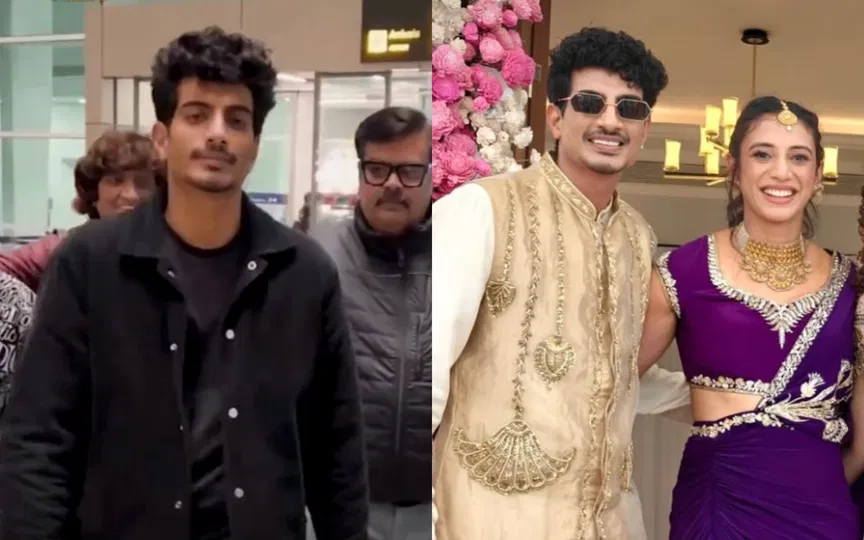
![What the Mandhana–Muchhal story says about us [Source: @Mahi_729/X.com]](https://onecricketnews.akamaized.net/parth-editor/oc-dashboard/news-images-prod/1765208212401_Smriti_Mandhana_Palash_Muchhal.jpg?type=hq) What the Mandhana–Muchhal story says about us [Source: @Mahi_729/X.com]
What the Mandhana–Muchhal story says about us [Source: @Mahi_729/X.com]
There was a time when a wedding was a private affair. A personal milestone shared with family, friends, and perhaps a few colleagues.
That line, sacred and unquestioned, has now been trampled by a dangerous combination of obsessive fandom, hyperactive algorithms, and a media culture addicted to speed instead of sense.
In today’s world of instant updates and endless speculation, the postponement of Smriti Mandhana and Palash Muchhal’s wedding became something far more disturbing than a personal crisis, as it became a public spectacle, a digital court trial broadcast in real time.
From concern to gossip in a matter of hours
At first, there was empathy. Reports claimed Smriti’s father had shown heart-attack symptoms and was hospitalised. Shortly after, news also surfaced that Palash had been admitted to the hospital under unclear circumstances.
Any reasonable society would have paused there. Health, after all, is not a headline, it’s a boundary. But in the vacuum of uncertainty, rumours found oxygen.
Within days, whispers on anonymous platforms like Reddit suggested that Palash had allegedly cheated on Smriti with their wedding choreographer just a day before the ceremony.
No evidence. No verification. Just speculation. It should have stayed exactly where it belonged, in the dark corners of the internet. Instead, it graduated into mainstream conversation. The algorithm did the rest.
Journalism became a mob
Soon, timelines filled with theories, judgment, and outrage. Palash Muchhal was declared guilty by strangers who knew neither his truth nor his life. Smriti Mandhana was thrust into the role of a betrayed woman, stripped of nuance and individuality.
And then, in the most twisted turn of all, even she became a target of suspicion, accused of hiding facts, of playing a narrative, of dishonesty.
Two people navigating an intensely private, painful situation suddenly became characters in a national soap opera. This wasn’t journalism. This was voyeurism.
Journalism exists to inform the public about what matters, such as governance, justice, performance, and wrongdoing that impacts others.
It is not meant to perform autopsies on a stranger’s heartbreak. Even if every single rumour had been true, which remains unproven, the question we should be asking is simple: Was it ever our story to tell?
A woman calling off her wedding is not a public issue. A relationship breaking apart is not a national emergency. A family going through emotional turmoil is not “breaking news.”
And yet, senior journalists, portals, influencers and fan pages rushed to be the loudest voice in the room. Privacy was no longer a right. It was collateral damage for clicks.
Smriti Mandhana became the loneliest woman in a crowded timeline
In the process, Smriti Mandhana, a World Cup winner, a role model, and a pioneer for women’s cricket in India, was reduced to content. Her achievements blurred behind gossip. Her resilience disappeared behind speculation.
Everything she had earned on the field was momentarily eclipsed by what strangers believed she had lost off it. This is where the real discomfort lies.
India loves to celebrate its heroes, but it also loves to tear them apart. We place women on pedestals, then tear through their private lives with the same breath.
We claim to be protective, traditional, and family-oriented. Yet behave like digital voyeurs the moment vulnerability presents itself. The Mandhana–Muchhal episode did reveal a broken relationship. But it also revealed a broken value system.
Privacy is a thin line we no longer respect
The most heartbreaking part of this situation was that Smriti Mandhana was eventually forced to issue a public statement asking for privacy, something no one should ever be compelled to do.
Imagine having to publicly request space to grieve, process and heal. That is not the privilege of fame. That is its punishment.
This must not be mistaken for curiosity. It is entitlement. Entitlement to know why. Entitlement to judge. Entitlement to participate in someone else’s trauma.
It is the same regressive mindset that makes neighbourhood aunties whisper behind curtains, except now it has internet access and a verified tick.
What we witnessed is more than just gossip gone wrong. It was the erosion of ethical boundaries between public and private. It showed how badly media houses want to win the race to be first, even if it means being wrong and cruel.
Ethics died in the age of trending
And while timelines were busy dissecting a postponed wedding, the real stories waited in the background about the future of Indian women’s cricket, Smriti’s next season, Palash’s creative journey, and the mental health of public figures under relentless scrutiny.
Stories that required thought and respect instead of intrusion and noise. But those are not as easy to sell as a scandal.
And so a painful, deeply human moment was turned into content. The line wasn’t just crossed. It was erased.
The frightening truth is that if nothing changes, it will happen again. To another woman. Another man. Another “power couple”. Another moment that should have been met with silence, but instead was met with spectacle.
Because somewhere along the way, we forgot a fundamental truth:
Not every story belongs to us just because we can see it. Not every silence needs a microphone. And not every life is ours to publish.
.jpg)


.jpg?type=mq "Alex Carey appreciation post")