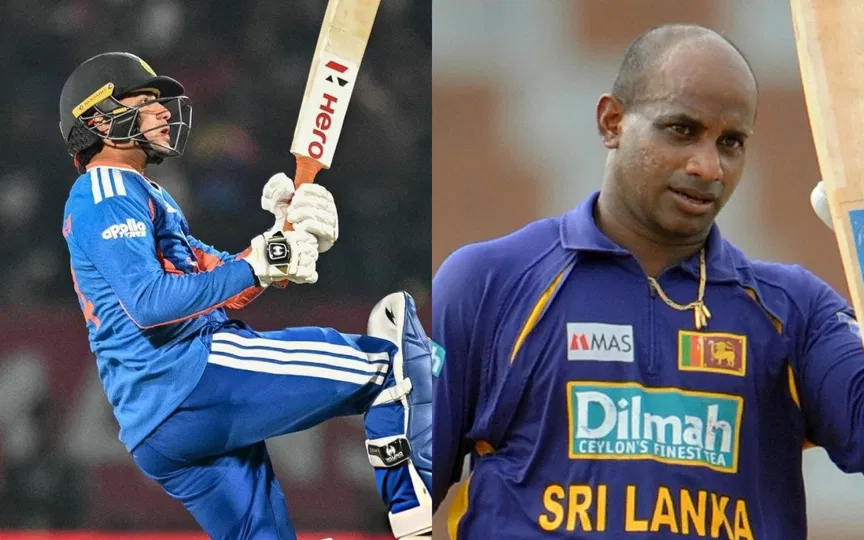
.jpg?type=hq) Abhishek Sharma (Source: AFP)
Abhishek Sharma (Source: AFP)
India opener Abhishek Sharma once again displayed his batting prowess with knock of 35 runs off just 18 balls, with three fours and three sixes against South in the third T20I of the five-match series. With the third six during his knock, he achieved an amazing milestone of hitting 300 sixes in his T20 career, including international, domestic, and the Indian Premier League (IPL).
Meanwhile, Abhishek Sharma also joined the list of very few batters who have smashed 300 or more sixes in their T20 careers. Apart from that, Sharma’s six-hitting abilities and aggressive approach also seems to be a reflection of the changing paradigm of top-order batting in the shortest format of the game.
Hence, here’s a look at a few of the batters who have showcased completely a different kind of approach in the T20s, while batting up in the order.
The game of six-hitting efficiency
Whenever it’s about batting in the opening slot or at either of the top three batting positions, there used to be a concept of adapting a steady approach to give the team a stable start, even in the T20 format. But, the modern-day batting approach of the batters has changed the dynamics of the game.
Now, most of the top-order batters decide to hit the big shots from the first ball of the game. This ultra-aggressive and modern-day approach has changed the dynamics of the quickest format of the game. It has also driven the quickest format of the game to its more advanced and fast-paced version.
Now, the game has come to the six-hitting efficiency of the batters and their ability to hit sixes as maximum as possible per innings.
Most efficient six-hitters in top order (Batting position: 1 to 3)
| Batters | Innings/Sixes | Efficiency (Sixes-per-innings) |
| Abhishek Sharma | 141/288 | 2.04 |
| Finn Allen | 159/280 | 1.76 |
| Jos Buttler | 229/368 | 1.60 |
| R Gurbaz | 237/370 | 1.56 |
| Faf du Plessis | 233/333 | 1.42 |
The above list shows the most efficient six-hitters among top 10 batters with the most sixes in T20s since Abhishek Sharma’s debut. Abhishek Sharma tops the list as the most-efficient six-hitter with sixes-per-innings rate of 2.04, hitting 288 sixes in 141 innings while batting from number one to three.
He is being followed by his contemporary Finn Allen with 1.76, who made his debut just a year and a half before Sharma started his T20 journey. Furthermore in the list, the veteran England wicketkeeper-batter Jos Buttler is there, with an efficiency rate of 1.60, hitting 368 sixes in 229 innings.
Young Afghanistan wicketkeeper-batter Rahmanullah Gurbaz is on the fourth spot, with an efficiency of 1.56 sixes per innings, hitting 370 sixes in 237 innings. Former Proteas skipper and the blistering batter Faf du Plessis is the last name in this list of top five most efficient six-hitters since Abhishek Sharma’s debut. Du Plessis has smashed 333 sixes in 233 innings, with an efficiency of 1.42.
An approach-comparison between modern-day batters and the veterans
Apart from six-hitting efficiency in the modern-day T20 cricket, there comes a point when the discussion will be incomplete without comparing the approach of the current-generation batters who have debuted around Abhishek’s debut with the veteran batters who have been playing the game before his debut for over the years.
This list of veteran batters includes the likes of former England opener Alex Hales, star Pakistan batter Babar Azam, former Proteas skipper Faf du Plessis, English veteran Jos Buttler, New Zealand’s Colin Munro, former Aussie great David Warner, and the modern-day batting great from India, Virat Kohli.
Most efficient six-hitters among the veteran batters
| Batters | Innings/Sixes | Efficiency (Sixes-per-innings) |
| Jos Buttler | 229/368 | 1.60 |
| Faf du Plessis | 233/333 | 1.42 |
| Colin Munro | 240/311 | 1.29 |
| Alex Hales | 337/417 | 1.23 |
| Virat Kohli | 157/182 | 1.15 |
| David Warner | 175/157 | 0.89 |
| Babar Azam | 174/236 | 0.73 |
Now, speaking of the approach of the above-discussed batting veterans, Jos Buttler, Faf du Plessis, Alex Hales, Colin Munro, and Virat Kohli have been the batters who seem to have adapted with the demands of the modern-day T20 cricket.
But surprisingly, the former Aussie great Warner has a six-hitting efficiency of just 0.87 despite having a strike rate as good as Colin Munro. It further translates into the fact that Warner has scored the runs, testifying with the better average than Munro but the former has scored these runs with his traditional ‘busy in the middle’ approach instead of taking six-hitting as first preference.
But, there’s one batter, the Pakistan star Babar Azam, who doesn’t seem to get changed with the changing paradigm and evolving demands of T20 cricket. His slow strike rate and sluggish approach has been one of the most debated topics among the cricket experts.
Conclusion: The time and dynamics have changed in T20 cricket
After an above-explained dissection of the six-hitting efficiency and its comparison between the modern-day batters and the ones who have been there for over a decade or more, it becomes quite clear that the dynamics of T20 cricket have changed completely.
Gone were the days when batters used to adapt a steady approach to get settled in the middle but the current generation of batters, including the likes of Abhishek Sharma and Rahmanullah Gurbaz loves to hit the ball for the maximums from the first ball of the innings.
.jpg?type=mq "Tim Seifert madness in BBL")