

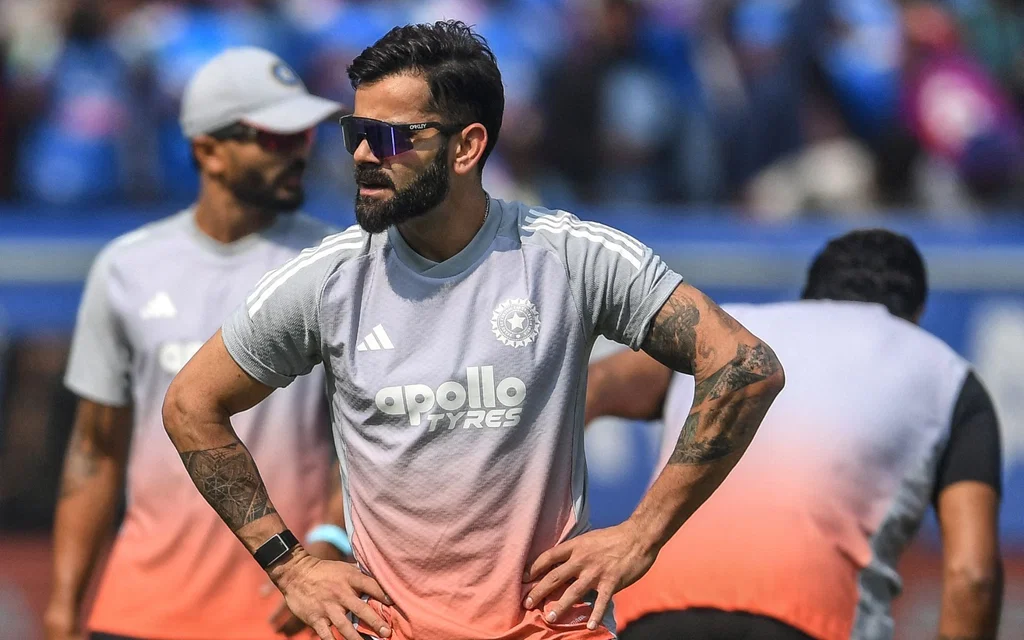
 Virat Kohli (Source: AFP)
There are two famous cricketing notions behind any player featuring in the domestic cricket. Firstly, he is a young, promising cricketer proving himself to earn an international call-up. Secondly, he is an established player struggling with his form in international cricket and steps into domestic cricket to get his lost rhythm.
But the story seems quite complex and confusing in the case of the modern-day batting legend Virat Kohli’s return to the Vijay Hazare Trophy. Neither of the above-discussed cricketing notions fits to justify the Board of Control for Cricket in India’s (BCCI) urge to make Kohli appear in domestic cricket.
After a string of some weird developments in Virat Kohli’s return to the domestic cricket, this article delves into the efforts of finding a relevance and valid ground for this forced decision.
What management wants to achieve with this
Two successive ducks for Virat Kohli in the first two ODIs against Australia ignited a debate portrayed as ‘Virat Kohli is done’. But the 37-year-old made a dominant comeback immediately with his 74-run knock and a match-winning partnership with his long-time batting partner, Rohit Sharma. Kohli’s batting masterclass in the ODIs against South Africa followed his comeback knock against Australia.
Virat Kohli in ODIs against South Africa
| Criterion | Data |
| Innings | 3 |
| Runs | 302 |
| Average | 151.00 |
| Strike Rate | 117.05 |
| Highest | 135 |
| 50s | 1 |
| 100s | 2 |
The batting maestro ended up as the leading run-scorer in the series, with 302 runs in just three innings with an average of 151.00, hitting two consecutive centuries and a half-century in the final fixture.
Neither form seems to be an issue for Kohli, nor does he have anything left to prove after 17 years of serving the Indian cricket team at the highest level of the game. Besides that, if it is about keeping Kohli in the groove, considering his presence in only one format, then the India are set to host New Zealand in a three-match ODI series from January 11 onwards.
But what left everyone in surprise was the BCCI’s standstill stance on Kohli’s appearance in the Vijay Hazare Trophy 2025-26. It also leaves everyone in the Indian cricketing circuit with a question: ‘What management actually wants to achieve with this stubborn approach of making Virat Kohli play in the domestic List-A tournament?’
.jpg)
The relevance or ground of the steps taken in Virat Kohli’s VHT return
Even if Virat Kohli’s form or ‘anything to prove’ point are left aside, what makes management’s intent more skeptical is their approach in managing Kohli’s return to the domestic List-A tournament. Earlier, it was decided that Delhi’s games featuring Kohli will be held at the M Chinnaswamy Stadium in Bengaluru.
But what followed was something that might not sit well with a lot of people in the Indian cricketing circuit, be it analysts, fans, or the former cricketers. After shifting the games to the fans’ favourite and Kohli’s home ground in the IPL, the M Chinnaswamy Stadium, reports understand that fans will not be allowed to enter the stadium to watch their favourite cricketer play in Bengaluru. It all happened after the games were again moved away from Chinnaswamy to the outskirts of Bengaluru.
These games will also not be aired live on television or OTT for fans to watch, which raises further questions about the BCCI’s intent to have their megastar in domestic cricket. If fans are not allowed in the stadium, the match will not be live, so how will one justify the actual motive behind Kohli’s presence in the Vijay Hazare Trophy 2025-26?
Conclusion: Really a need or just satisfying ego
Undoubtedly, Kohli’s return to the Vijay Hazare Trophy 2025-26 has made the list-a tournament the most-talked-about topic in the Indian cricketing diaspora. But the above discussion also leaves us with a few legitimate questions about the logic and reasoning behind a forced approach to have Kohli in VHT.
If the BCCI really wants to promote the domestic cricket by having their established stars in it, then what is the logical justification behind not telecasting the matches live? Last but not the least, if they want the fans to take interest in the grassroots cricket, then how will they justify the no-entry for fans in the stadium when one of your all-time cricketing legends is set to feature in a domestic list-A tournament?
.jpg)

.jpg?type=mq "How have the Costliest IPL 2026 buys performed")
