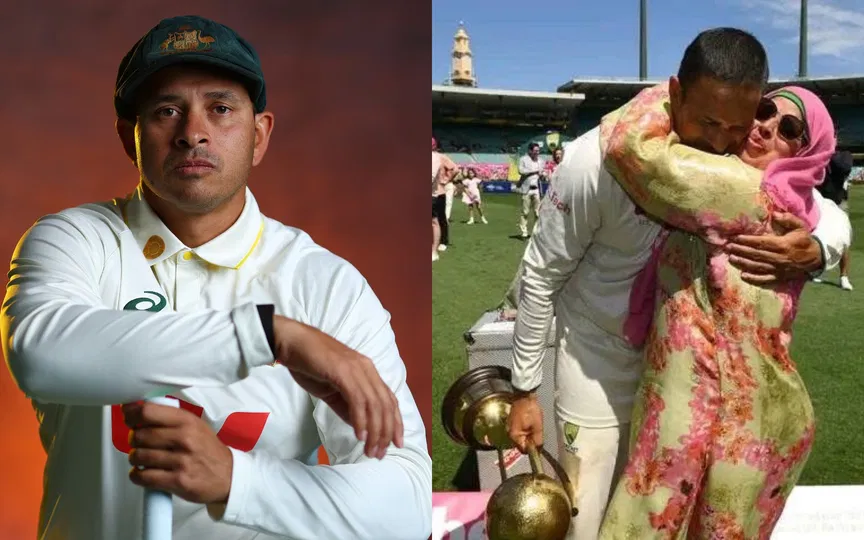
![Usman Khawaja's ethnicity, origin and life in Australia [Source: @ICC/X.com]](https://onecricketnews.akamaized.net/parth-editor/oc-dashboard/news-images-prod/1767340053225_Usman_Khawaja_Australia.jpg?type=hq) Usman Khawaja's ethnicity, origin and life in Australia [Source: @ICC/X.com]
Usman Khawaja's ethnicity, origin and life in Australia [Source: @ICC/X.com]
Usman Khawaja, after 15 years of serving Australian cricket, has bid goodbye to his international career. The upcoming fifth Ashes 2025 Test at the SCG will be the final outing in national colours.
In his retirement announcement, Khawaja spoke at length about his journey, as to how he battled racism and made his mark despite being a man of colour.
As his remarks explode on the internet, let’s look at Khawaja’s ethnicity and his journey from being a migrant to an Australian hero.
.jpg)
Usman Khawaja was born in Pakistan
Born in Islamabad, Pakistan, in December 1986 to a Muslim household, Usman Khawaja moved to Australia with his family when he was just four years old. Like many migrant families, the Khawajas arrived with hopes of stability and opportunity, settling in western Sydney.
Cricket became Usman’s bridge into Australian society, but it was never an easy passage. From his earliest days in school and junior cricket, Khawaja faced racial abuse that went far beyond sledging.
Opposition players and even parents, according to Usman, hurled slurs at him, often quietly enough so only he could hear. Being called a “curry muncher” or questioned for his background became routine.
Those experiences left scars. Usman Khawaja has spoken openly about how, for a long time, he did not even support Australia in sport.
Like many children of migrants, he gravitated towards teams from the subcontinent, Pakistan, India, and Sri Lanka, because they felt safer and more familiar.
Yet, over time, both Khawaja and Australia changed. By high school, he had embraced the Australian identity fully, believing that the country could make space for people like him, people of colour.
Entry into Australian cricket as a migrant
In 2011, Usman Khawaja made history by becoming the first Australian Test cricketer of Pakistani origin. It was a moment of pride, but it did not end the stereotypes.
Throughout his career, he battled a persistent narrative that painted him as “lazy” or “soft," labels he believed were rooted as much in racial and cultural bias as in cricketing assessment.
When injuries struck, his commitment was questioned in ways others rarely experienced.
Khawaja’s strong stand towards his faith
Faith has also been central to Khawaja’s identity. A practising Muslim, he never hid his beliefs, yet he never allowed them to interfere with his professionalism.
He played comfortably and successfully for Australia for over a decade, captaining Queensland and becoming a senior figure in the Test side. His career stood as quiet evidence that faith and national representation are not opposites.
That balance, however, was tested most publicly in late 2023, when Usman Khawaja wore shoes bearing messages supporting human equality and freedom, coloured in the Palestinian flag.
The ICC warned him of sanctions for making political statement, and he was later told that even wearing black armbands breached regulations.
Khawaja complied, but he also spoke out, pointing to what he saw as double standards as religious symbols, social justice gestures, and political statements by others had often been allowed.
His comments triggered a heated debate, but they also revealed something deeper. Usman Khawaja was not rejecting Australia or cricket’s institutions. He was asking them to live up to their own principles.
Former players like Michael Holding and teammates like Pat Cummins backed him, arguing that his stand was measured, not disruptive.
Usman Khawaja reiterated his beliefs while retiring
Even at his retirement press conference on January 2, 2026, Usman Khawaja returned to the same theme. He spoke of Islamophobia, of stereotypes that still resurface when things go wrong, and of the emotional toll of constantly being scrutinised differently.
Yet there was no bitterness. Only a hope that the next child from a migrant, Muslim, or Pakistani background would find the path smoother than he did.
Usman Khawaja leaves cricket as one of Australia’s finest modern batters and a reminder that belonging is not granted. It is claimed, earned, and defended with dignity.
 (1).jpg?type=mq "All major ICC events this year!")
.jpg?type=mq "Replacements for Sai Sudharsan")