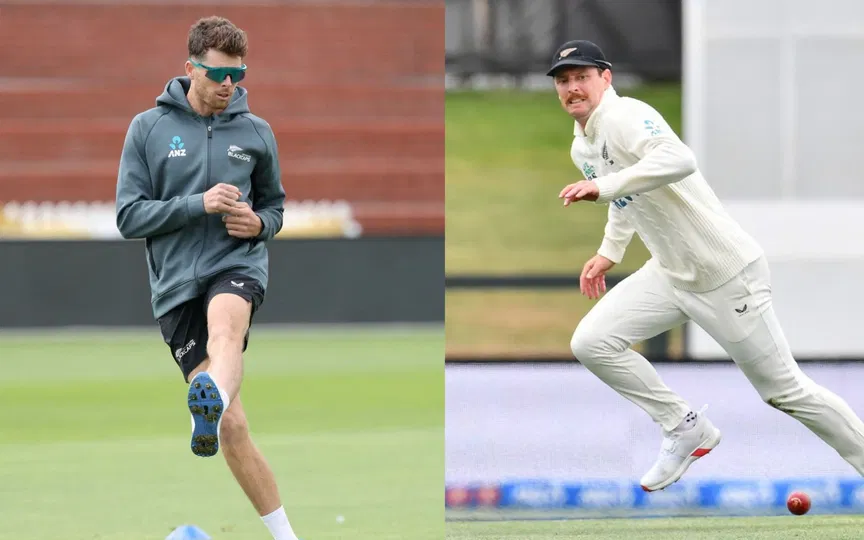
Zak Foulkes (R) with Nathan Smith (L) (Source: AFP)
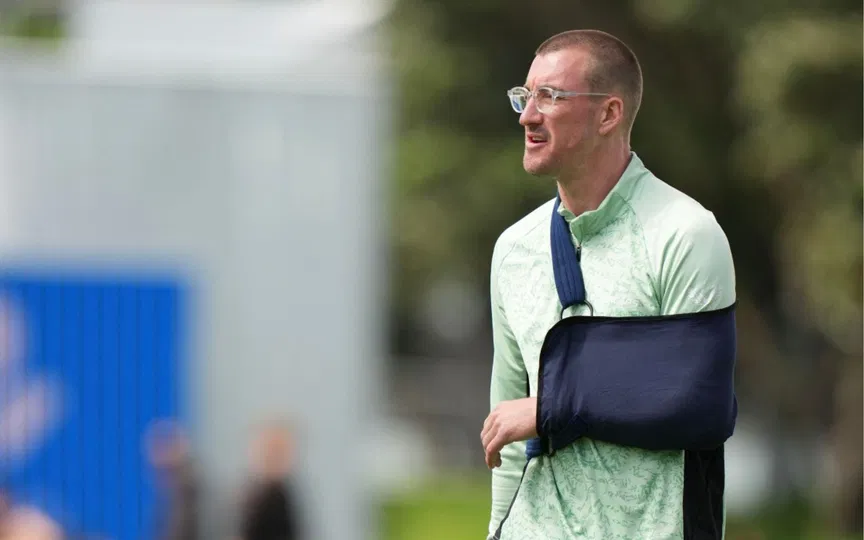
New Zealand’s injury woes doesn’t seem to stop as almost all of their frontline pacers are now out of the side owing to their injuries. The recent name in this list is of Blair Tickner who injured his shoulder in an attempt to stop a boundary at fine-leg region on the first day of the second Test against West Indies. Prior to his injury, Tickner produced the best bowling figures (4/32) of his short but promising Test career.
After Tickner’s early exit from the game, the hosts have been left short with three pacers as the game is heading towards the third day. Apart from a crisis in this game against the Caribbean side, the injury issues have also raised the concerns around the pace-bowling future and stability of pace attack for Tom Latham-led New Zealand.
With Jacob Duffy and Michael Rae already being in their 30s raises the questions around the potential void around the young pacer Zak Foulkes who could be a long-term prospect for the Kiwis. This also leaves the NZ team management with a question around finding the perfect ‘choice of pacers’ to team up with Foulkes to establish a stable and long-term pace attack.
Hence, here a look at the factors influencing the future of pace attack for New Zealand and putting their pace-bowling legacy under a diameter full of questions and conundrums.
What does the void around Zak Foulkes mean for New Zealand?
The ‘void around Foulkes’ is in the nucleus of this entire pace-bowling concern for New Zealand because of its seriousness. The four out of six injured and ruled-out pacers, are in their 30s and their recovery from the injury could be a tough phase to bear both for them and New Zealand. This list of 30+ pacers includes Matt Henry, Lockie Ferguson, Adam Milne, and Blair Tickner.
New Zealand's injured pacers at present
Bowler
Age
Injury
Injury Nature
Matt Henry
33 Y 362 days
Calf
Moderate but age factor
Lockie Ferguson
34 Y 181 days
Hamstring
Moderate but age factor
Will O'Rourke
24 Y 127 days
Back
Serious and Career-Changing
Adam Milne
33 Y 242 days
Ankle
Recoverable but age factor
Ben Sears
27 Y 303 days
Hamstring
Easily Recoverable
Blair Tickner
32 Y 59 days
Shoulder
Recoverable but age factor
Besides that, the current companions with the 23-year-old Foulkes, Michael Rae and Jacob Duffy are also in their 30s, which doesn’t give NZ think-tank an edge to think around them their pace-bowling future.
The only two pacer left in the bracket of under 30s or who possibly could team up with Foulkes for a long term, Will O’Rourke (24) and Ben Sears (27). Out of these two, the comeback for Sears doesn’t seem to be a very difficult one as he has a hamstring injury which might recover with time.
But what could be a major concern for New Zealand is the back injury of the young Will O'Rourke, which also comes up with the possibilities of impacting his pace, body reflexes, and other factors after making a comeback. Not to forget, the career of everyone’s favourite and former sensational Kiwi pacer, Shane Bond (87 wickets in just 32 innings of 18 Tests he played) happened to be short-lived just because of his chronic back injuries.
The beloved pace-bowling legacy under jeopardy
Some of New Zealand's famous pace-bowling trios
Era
Dominant Pace Trio
1970s-80s
Richard Hadlee, Bernard Lance Cairns,
and Ewen Chatfield
1990s-Early 2000s
Simon Doull, Dion Nash,
and Nathan Astle (debuted in 1996)
Late 2000s, 2010s,
and Early 2020s
Tim Southee, Trent Boult,
and Neil Wagner
Notably, New Zealand are known for having one of the most beloved pace-bowling legacies amongst a few of the big cricket teams, especially in Tests. There was a time in the 70s and 80s when the trio of Richard Hadlee, Bernard Lance Cairns, and Ewen Chatfield used to grace the Kiwi pace attack.
The legacy of this pace duo was later carried by Simon Doull, Dion Nash, and Nathan Astle who became part of this trio in 1996 and stayed in the mix till 2006. Furthermore, in the late 2000s, entire 2010s, and early 2020s, the Kiwi pace-bowling legacy ran on the shoulders of a decorated trio, including Tim Southee, Trent Boult, and Neil Wagner.
After witnessing such amazing pace trios over the decades, a concerning time is eyeing New Zealand due to a void around Foulkes, alongside inconsistent availability of young and quality pacers who could team up with him to create a long-term pace trio for New Zealand.
Conclusion: A time to keep an eye on Plunket Shield
Now, after facing a string of injury hits and losing their six frontline pacers, it’s the ‘need of the hour’ for New Zealand to keep a close eye on their premier first-class domestic tournament, Plunket Shield to scout at least two perfect picks who could make a good trio with Zak Foulkes in a long run.
The two names who stand out as top contenders are, Simon Keene (24) and Joshua Brown (25). Both the pacers have impressed with their brilliant performances in the ongoing Plunket Shield 2025-26. Keene has been one of the key pacers for Auckland while Brown has been one of the vital cogs in the wheel for the Northern Districts in the tournament so far.
Simon Keene in Plunket Shield 2025-26
Criterion
Data
Age
24
Innings
6
Wickets
12
Average
19.58
Economy
2.86
4w
1
5w
0
BBI
4/36
Joshua Brown in Plunket Shield 2025-26
Criterion
Data
Age
25
Innings
6
Wickets
11
Average
25.09
Economy
3.13
4w
0
5w
0
BBI
3/34
Keene has claimed 12 wickets in six innings of the three games he has played, with a decent average of 19.58, including a four-wicket haul (4/36). Speaking of Brown, he has bagged 11 wickets in six innings, with an average of 25.09, registering the best bowling figures of 3/34 in an innings.
So, this could be a perfect choice to join the young Zak Foulkes in New Zealand and this trio has knack for serving the Kiwi cricket for a long period of time as they have a long way to go in thier respective careers.


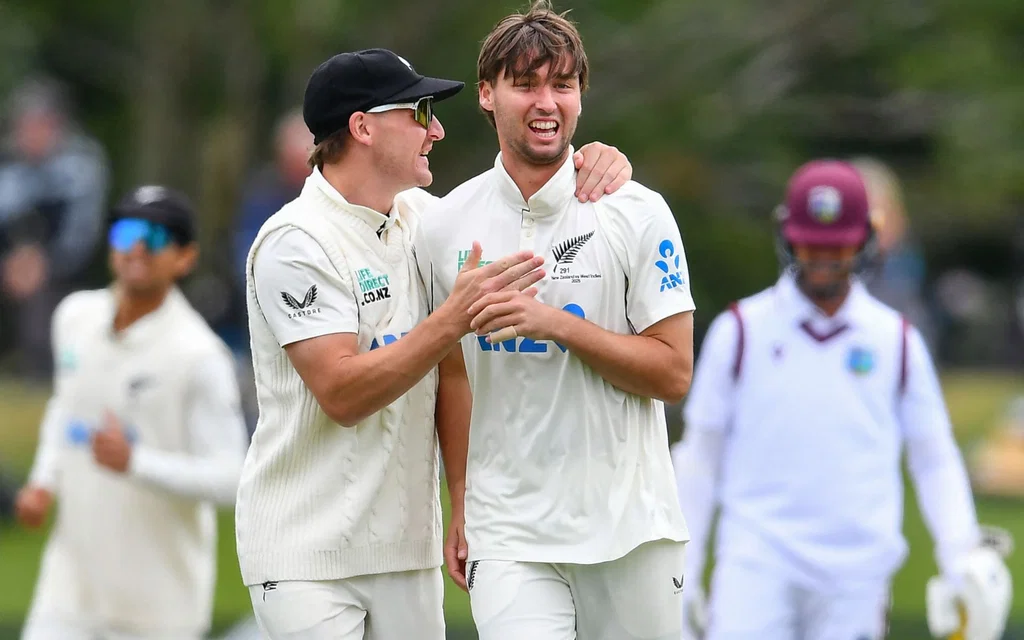 Zak Foulkes (R) with Nathan Smith (L) (Source: AFP)