![Spin losing its charm in Australia [Source: @FoxCricket, @OneCricketApp/X.com]](https://onecricketnews.akamaized.net/parth-editor/oc-dashboard/news-images-prod/1767629077383_Australia_Spin_Death_Ashes.jpg?type=hq) Spin losing its charm in Australia [Source: @FoxCricket, @OneCricketApp/X.com]
Spin losing its charm in Australia [Source: @FoxCricket, @OneCricketApp/X.com]
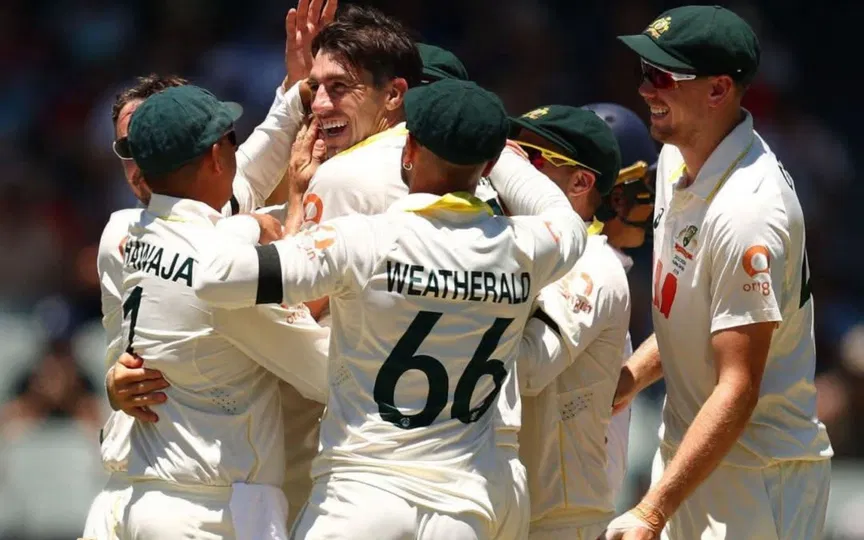
For the first time since 1888, Australia walked out at the Sydney Cricket Ground without a specialist spinner. At a venue once synonymous with finger marks and fourth-innings drama, Todd Murphy sat unused while Australia loaded up on seam.
What once would have been unthinkable has quietly become logical. Spin, in Australian home Tests, is no longer central. It is peripheral.
This wasn’t a pink-ball anomaly or a one-off experiment. Brisbane, Melbourne, and now Sydney have all followed the same script during the Ashes 2025-26.
The message is unmistakable. Australian conditions no longer demand spin, and team selections are reflecting that reality.
Australia’s obsession with lush green decks
| Criterion | SCG | MCG | Adelaide |
| Innings | 43 | 24 | 27 |
| Overs | 642.4 | 380 | 383.3 |
| Wickets | 47 | 36 | 35 |
| Average | 43.8 | 30.08 | 35.74 |
| Economy | 3.2 | 2.85 | 3.26 |
| 5-fers | 2 | 0 | 0 |
(Table: Spinners stats in Test cricket on Australia grounds since 2020)
More than philosophy, the biggest culprit is preparation. Australian curators have leaned heavily into green, seam-friendly pitches, often leaving 8-10 mm of grass on the surface.
The intention is to ensure results, avoid flat tracks, and satisfy the World Test Championship’s emphasis on wins over draws. But the unintended consequence has been a near-erasure of spin from the contest.
Statistically, the decline is stark. Across this Ashes series, spinners from both teams have bowled just over 130 overs combined, the fewest deliveries by spin in any Test series of three or more matches played in Australia.
Eight of the nine wickets taken by spinners came in Adelaide alone. Outside that Test, spin has barely existed.
Spinners’ declining stats since 2020
| Criterion | Spinners | Pacers |
| Innings | 136 | 430 |
| Overs | 1993 | 6147.5 |
| Wickets | 167 | 771 |
| Average | 37.8 | 25.96 |
| Economy | 3.16 | 3.25 |
| 5-fers | 3 | 30 |
(Table: Spinners vs Pacers stats in Test cricket in Australia since 2020)
Zoom out further, and the trend deepens. Since 2020, spinners in Australia have averaged close to 38 runs per wicket, compared to sub-26 for pace bowlers.
Seamers have also struck far more frequently, with a strike rate under 50 balls, while spinners are operating closer to 70.
In simple terms, spin has become slower, more expensive, and less threatening. Not because of skill erosion, but because conditions have stripped it of relevance.
Even Nathan Lyon, Australia’s most reliable spinner of the past decade, has his poorest home average at the SCG. That alone would once have prompted pitch introspection.
Instead, the response has been selection adaptation, fewer spinners, more quicks, and more grass.
5-day Tests have become rare Down Under
The result has been an extreme skew in match balance. Tests are ending inside two or three days with alarming regularity. The Melbourne Test barely survived into the third afternoon. Perth was over in two.
When seam dominates to this degree, the game compresses. Batters are denied time, spinners are denied rhythm, and matches are decided before tactical layers can develop.
Ironically, this doesn’t even guarantee control. In Sydney, once England survived the new ball, Australia’s one-dimensional attack began to look blunt.
Joe Root and Harry Brook settled in, partnerships flourished, workloads mounted, and part-time bowling crept in. The absence of spin was felt not just as a wicket-taking option but as a release valve.
Someone to change pace, alter angles, and give fast bowlers rest. This is where the logic fractures. Even on green pitches, spin has value. Drift, dip, variation of speed, and pressure through control do not require a raging turn.
Good bowlers remain good bowlers, regardless of conditions. Yet Australia has increasingly treated spin as a luxury rather than a tool.
Australia is depleting its spin depth
There is also a long-term cost. Nathan Lyon is nearing the end. Murphy, Corey Rocchiccioli, Matt Kuhnemann, and others need exposure, not just overseas, but at home.
Shield cricket, played largely on similar seam-heavy surfaces, does little to prepare them for long spells or match management. When spin is finally needed again, the cupboard may look worryingly bare.
Australia’s success in this Ashes makes the issue easy to ignore. Winning masks the imbalance. But the health of Test cricket depends on the diversity of skills, conditions, and pathways.
A summer where spin is sidelined, matches finish in two days, and one discipline dominates is not progress.
This may be a phase, as Daniel Vettori suggests. Or it may be a warning sign. Either way, the fifth Test at the SCG felt like a line crossed.
When a venue built on spin no longer needs one, something fundamental has shifted, and not for the better.
.jpg?type=mq "India’s 2009 T20 World Cup horror")

 (1).jpg?type=mq "Asian Cricket in Jeopardy")
.jpg?type=mq "Joe Root in the Pantheon")