![Justin Greaves and Kemar Roach [Source: @TheYorkerBall/X.com]](https://onecricketnews.akamaized.net/parth-editor/oc-dashboard/news-images-prod/1765000137018_Greaves_Roach.jpg?type=hq) Justin Greaves and Kemar Roach [Source: @TheYorkerBall/X.com]
Justin Greaves and Kemar Roach [Source: @TheYorkerBall/X.com]
The red Kookaburra balls were beaten to the absolute last thread as West Indies, facing a seemingly impossible task, batted with incredible heart on the final day to secure a memorable draw against New Zealand in the first Test at Hagley Oval.
Chasing a record 531 for victory, they instead staged a magnificent rearguard action, finishing on 457 for 6 thanks to an unbeaten double century from Justin Greaves and a stubborn fifty from Kemar Roach. Let's take a look at how things panned out at Christchurch.
The Kiwis dominate the first four days
The first four days were dominated by New Zealand. After being bowled out for 231, thanks to a five-wicket haul from Jacob Duffy, the Kiwis took control.
A massive second-innings partnership of 279 between Tom Latham (145) and a brilliant Rachin Ravindra (176) allowed them to declare at 466 for 8, setting a mammoth target of 531.
The West Indies' first innings had folded for 167, meaning they needed to produce something extraordinary just to survive.
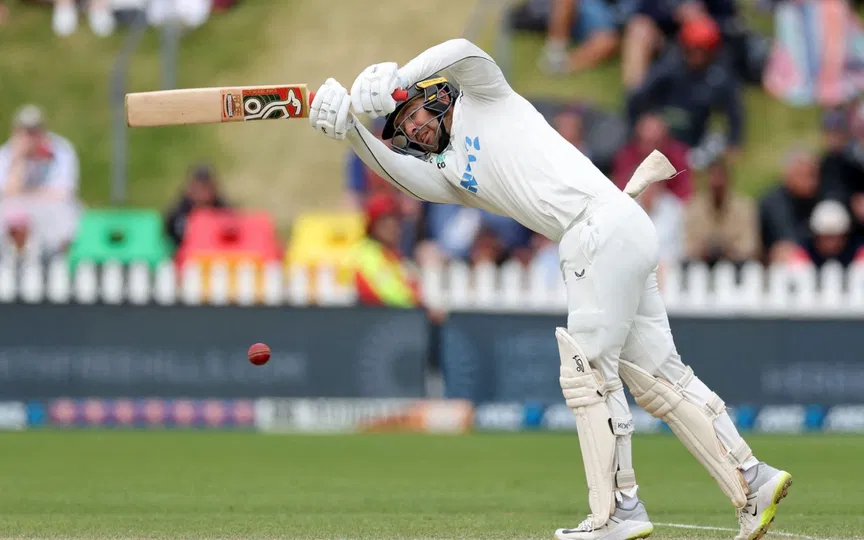
The Greaves-Roach wall that defended the Kiwi attacks
The final day began with all the results possible. West Indies, at 212 for 4, needed 319 more to win but, more realistically, had to survive 98 overs to draw.
The set duo of Shai Hope and Justin Greaves started solidly, with Hope moving to a magnificent 140. His dismissal for 268 seemed to open the door for New Zealand.
When Tevin Imlach fell quickly, the West Indies were 277 for 6, still with over 60 overs to go. Victory was out of reach, and defeat looked likely.
The Greaves masterclass that saved the day for the visitors
This was the moment Justin Greaves decided to own the day. Joined by tailender Kemar Roach, he transformed from a steady partner into a monumental figure.
Greaves built his innings while punishing loose balls and standing like a wall. As the overs ticked by, his milestone grew first to a century, then 150, and finally, a glorious maiden first-class double century. His 202* off 388 balls was a masterpiece that was the bedrock of the great escape.
Kemar Roach stands as the other wall
At the other end, Kemar Roach, known for his fast bowling, wrote his own story of defiance. He offered a textbook example of how to bat for time. With a straight bat and immense patience, he simply would not be moved.
For 233 balls, he repelled everything New Zealand threw at him, scoring a priceless 58*. His partnership with Greaves was worth 180 runs, but its true value was in the 410 balls they consumed together, draining the life out of the Kiwi attack and the hopes of the home crowd.
The final stand and the fitting end
As the final session wore on, the match quietly slipped away from New Zealand, and after Greaves completed his 200, the teams eventually shook hands with just a few overs remaining, the scoreboard reading 457 for 6.
Greaves had his double century, Kemar Roach cherished his fifty, and the West Indies had one of their most famous draws that will once again make the head high of a side that has been hammered into the soil for their lean patch in every format of the game.



.jpg?type=mq "Are we in the death overs of international cricket?")